






Patio Lights Made Simple: How to Hang Outdoor String Lights the Right Way
Apr 15th 2026

Summer days – and nights – were made for outdoor living.
Hibernating all winter has its appeal, but warmer weather encourages us to get out and enjoy other activities. That could mean grilling and chilling in the backyard, hosting pool parties or serving cocktails under the stars.
When your outdoor space is equipped with patio lights, you don’t have to worry if the festivities continue after dark. Enjoy yourselves as long as you like by the soft glow of outdoor string lights.

Why Use Patio Lights?
If your outdoor living space lacks lighting, there are several good reasons to add it.
First, outdoor lighting expands the function of your patio, porch or deck. An adequately lit space means dining, conversation, games or just listening to the crickets doesn’t end when the sun goes down.
Second, if you’ve ever walked through your yard on a dark night, you might be surprised at how uneven a manicured lawn can be. Whether you're entertaining or just letting the dog out, patio lights lessen your chance of tripping or falling after dark. Good lighting around the exterior of your home makes stairs and pathways safer and also deters burglars.
Also, patio lights are just…pretty! Whether they’re tiny and twinkly or larger with a warm glow, outdoor patio lights add ambience and create an inviting space for all your summer activities.
As with any home improvement project, however, installing patio lights should be done thoughtfully. Here are some things to consider:

Plan Your Layout
Define Your Goal
Think about what you want to accomplish with your outdoor lighting and the best way to achieve that effect.
Some options:
Overhead lighting for a deck, porch, patio or pergola
Accent lighting on deck rails, stairs, pathways, garden edging
Ambiance lighting for outdoor dining
Defining an entertainment area
Choose Placement
How will you mount your lights? On an outdoor porch, the obvious choice is to hang lights from the ceiling or roofline. However, on an open patio or deck, you may need to anchor the lights to the house, a nearby tree, posts or poles.
Light Type
Several options exist for outdoor lighting. LED patio lights are energy efficient and long lasting. Many styles are available, including “smart” lines. Incandescent lights, such as Edison lights and bistro lights, cast a warm glow. Solar string lights make outdoor lighting possible even without a nearby power source.
Lighting Pattern
A straightforward layout places lights around the perimeter of the space, but creative light layouts add ambience.
To enhance visual interest, consider hanging lights in a zigzag, diamond, radial or grid pattern.
Trees make excellent anchor points for lights, although they may not be spaced out evenly. Take advantage of your terrain and play with your options to decide the best way to hang your outdoor lights.
Sketch it Out
Making a sketch or diagram of potential lighting arrangements can benefit the planning process, since they help you focus on the details and spot potential problems. Create multiple sketches to play with layout designs, plan anchor points and identify power sources.
Planning in advance can help you work through potential problems before you actually start hanging lights. This reduces delays spent solving issues in real time that can increase project frustration.

Measure the Area to Light
If you’ve sketched out your lighting plan, you may already have basic measurements. If not, now is the time to measure everywhere your lights will go.
While you measure, consider:
How high will you hang your lights? Factor in extra length to reach electrical outlets.
Hanging lights in patterns requires more length than straight runs.
String lights typically look best with a little sag, but don’t let them drape so deeply that people might walk into them.
If you’re stringing lights across a long span, consider using a guide wire to help draw the line tighter and keep it from swaying too much.
Here’s a simple measuring trick: Run a string along your planned layout, including draping and lead length to your outlet. Then measure the string.
The type of lights you use also plays into your lighting configuration. Typically, you can connect fewer incandescent lines to each other than you can with LEDs. This means you might need access to more than one outlet – a factor to consider when installing larger or more elaborate lighting designs.
You may also like:


Gather Supplies and Materials
Time to buy your lights! Now that you’ve measured, chosen a light style and hanging pattern, you can make a more informed decision about light string length and quantity. Make sure the lights you buy are rated for outdoor use.
Don’t forget lighting accessories like extension cords, weatherproof outlet covers and timers.
Depending on your method for hanging, you also will need mounting hardware, such as eye hooks, Q hooks, carabiner hangers or masonry hangers. Many lighting experts also recommend using zip ties to fasten string lights to poles and guide wires.
Poles and posts are alternative methods for hanging outdoor lights when natural or architectural features aren’t an option.
Poles 8 to 10-feet tall usually are recommended around patios and outdoor entertainment areas. You can also make your own poles from 4x4 posts. These may be attached to a deck, embedded into the ground or mounted in a large planter or bucket filled with concrete or gravel.

Prepare for Installation
You can save yourself a lot of grief if you test your lights before you hang them. It’s much easier to troubleshoot a faulty line or replace a burned-out bulb on the ground, rather than in the air.
Also, double-check that your layout easily reaches an outlet.
Make long cords less wieldy – and reduce the chance of breaking your bulbs – by removing the bulbs before hanging the lines. You can replace the bulbs as you go along, before you attach your cord to the next anchor point.

Install Mounting Hardware
Depending on where the hook is being installed, you may need to use different types of mounting hardware. Wood trim, posts and planters easily accept screw-in eye hooks. If mounting lights to a wooden building, try to mount hooks into a stud or sturdy beam, rather than siding or paneling.
Use masonry anchors with appropriate hooks when anchoring lights to brick, concrete or stucco.
You can drape or wind light strings around a tree branch, but wind, animals and gravity may move your lines over time. Friction from the line can fray the electrical line and cause a short or potential fire hazard. An electrical wire that constantly rubs on a branch could also strip away the bark, damaging the branch and providing access to harmful insects.
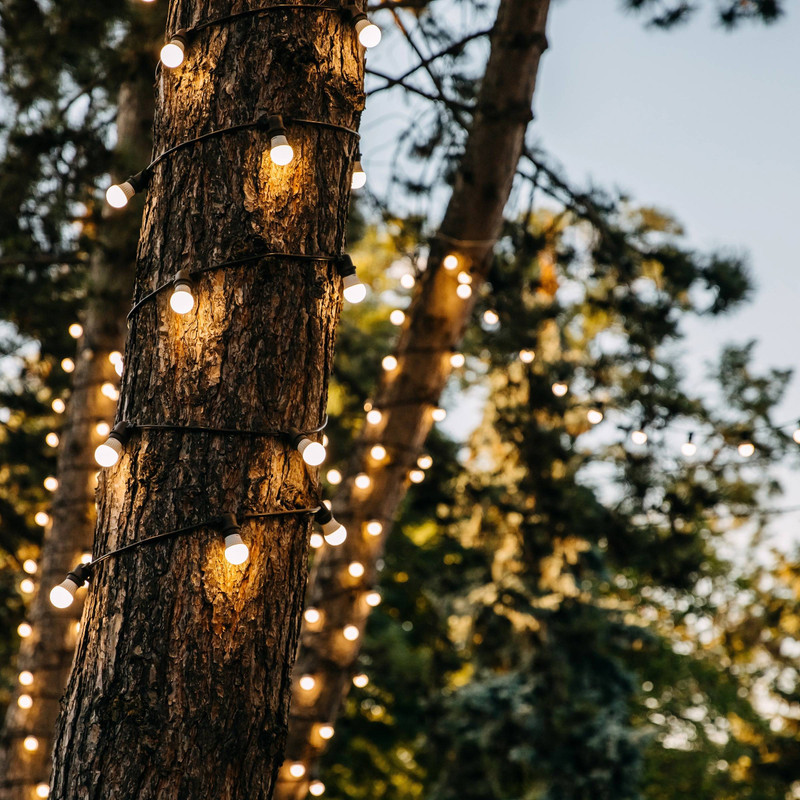
Instead, use heavy-duty hooks on tree trunks and pre-drill a lead hole for easier installation. For easier lighting, consider running your extension cord up the tree trunk to the string light plug.

Hang and Secure Lights
Start at the power source with the proper plug end.
For long spans, it’s a good idea to install a guide wire. This is a cable that runs between anchor points and can be pulled taut. Your outdoor lights are then attached to the cord, often using zip ties, to take stress off the electrical line and reduce sagging.
The easiest way to hang shorter lengths of string lights is to attach the lines directly to your anchor clips or hooks. Secure lights about every six to eight feet.
Lights that run under deck rails or on stair treads should be pulled tight. A slight droop adds to the aesthetics of patio lights that hang overhead. Draping lights is also a safer option for hanging lights. Excess tension on the wires can break internal wires, pull lights out of the sockets or cause anchor hooks to pull out.
Safety and Finishing Touches
While outdoor lights can withstand rough weather conditions, they are still electrical products. Anyone planning an outdoor light installation should take additional precautions to ensure they are used safely.
Only plug your patio lights into GFCI-protected outlets.
Do not overload circuits or exceed recommended string connections.
Seal plug connections to protect them from moisture.
To prevent tripping, to not allow cords to extend across walkways.
Ensure lights are high enough to avoid contact.
Make Final Adjustments
Once all your lights have been hung, stand back and examine the results. Dusk is a good time to evaluate the overall effect of your light placement.
Are the anchor points aligned? Do all the bulbs light? Does it look the way you wanted it to look?
If your lighting effect depends on a series of dangling lines, keeping the amount of sag consistent ensures an attractive, uniform look.
Start Small and Build
Hanging patio lights is a relatively simple do-it-yourself home improvement project that can add beauty and functionality to your outdoor areas.
If you can’t swing a full outdoor lighting plan right now, start with one layer and build on it seasonally. To begin, concentrate on key areas such as seating, dining areas or pathways, and layer in more lights over time.
With planning and preparation, you’ll be ready to tackle the task and enjoy expanded use of your exterior spaces well into the night all summer long!
Christmas Central Answers Your Questions About Patio Lights
What are the best outdoor patio lights to use in my backyard?
When deciding on the best patio lights to use outdoors, the most important consideration is safety. Only use waterproof outdoor lights. Check product packaging and online descriptions to ensure that they are “UL certified for outdoor use.” UL-approved outdoor lights are designed to safely withstand wet weather conditions and temperature fluctuations, protecting against electric shock hazard, short circuits and electrical fires.
What's the most energy-efficient outdoor lighting?
Adding outdoor lighting is an exciting upgrade. You want to make a wise investment by buying lights that don’t strain your electric bill and hold up season after season. That’s especially important when your patio string lights are draped across trees or stretched overhead, making it inconvenient to replace burned-out bulbs.
This is where LED patio lights shine. They use much less energy than incandescent bulbs to keep operating costs down. In addition, LED bulbs last thousands of hours longer than incandescents, meaning less maintenance and more time enjoying your space.
Where can I use my patio lights?
Consider the main features of your outdoor lights and the effect you want to create to determine the best light to use for each location.
Overhead: Long strings of outdoor lights with larger C9 bulbs, Edison bulbs or globe lights provide ample light for entertaining after dark. Choose warm white lights for a softer glow.
Railings and stair treads: Flexible rope lights and tape lights work well for areas that have lots of angles. Mount rope lights under a deck rail or twine them up posts for illumination without glare. Run rope lights up the sides of your stair treads for safer footing after dark.
Pathways: Path lights are a popular and pretty way to safely light a walkway. Path lights are typically low cost and come in many styles. Most are solar-powered, stake securely into the ground and are easily moved around so you can rearrange them or add more whenever you like.
Garden edging: Path lights and rope lighting are an excellent way to define the edge of your garden beds. They’re attractive and practical ambient lighting whether you’re entertaining or just letting the dog out.
Ambiance: Any type of outdoor lighting can add ambiance to your space, but for the best effect you’ll want to play to the strengths of each type of light.
For instance, because of their small size, mini lights and fairy lights evoke the enchantment of a starlit sky. LED mini lights look magical strung overhead or along a roofline, wound around porch posts and overhead slats on pergolas.
Because many fairy lights are battery-operated, they are often used for smaller applications. Twine them into wreaths or tuck them into a bottle for a look that’s homey and romantic
.
Add a little whimsy to your outdoor space with novelty lights. Fun and often colorful, theme string lights support a party theme or simply set the tone for your favorite summer activities.
Choosing the best outdoor patio lights for your backyard comes down to a balance of safety, efficiency and style. Start with lights rated for outdoor use, then think about how each type can enhance the way you use your space.

Get updates on the latest sales and featured items by subscribing to our newsletter below. New subscribers receive 10% off their first order!
Need help with decorating tips? Choosing the right tree?
Christmas Central Resources